How AI Works · 7 min read
Why GPUs Changed Modern AI — Even Though CPUs Are Faster at Individual Tasks
GPUs did not win AI because they are simply faster processors. They won because neural networks contain enormous amounts of mathematical work that can happen in parallel.
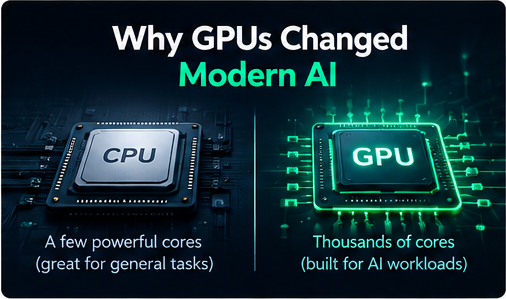
Here is a statement that sounds wrong the first time you hear it:
A CPU can be better at finishing an individual, complicated task quickly --- yet modern AI would be painfully slow at today’s scale without GPUs.
If a CPU is so capable, why did the AI industry become obsessed with GPUs?
The answer is not that a GPU is a universally faster computer.
The answer is that AI created a very particular kind of workload --- and that workload happens to match what GPUs are exceptionally good at.
To understand why, forget AI for a moment.
Imagine you have 10,000 small calculations to finish.
One option is to give them to a handful of extremely capable workers. Each worker can handle complicated instructions, switch between very different jobs, and finish an individual job quickly.
The other option is to put thousands of simpler workers in the same room and let them perform similar calculations at the same time.
Which team wins?
It depends on the work.
That sentence is the entire CPU-versus-GPU story.
A CPU was designed to be a brilliant generalist
The CPU --- Central Processing Unit --- is the general-purpose processor at the heart of a computer.
Your operating system uses it. Your browser uses it. A Java service uses it. A database uses it. A game uses it. A spreadsheet uses it.
Those workloads are messy.
One moment the processor may be evaluating a branch:
if paymentApproved:
    shipOrder()
else:
    cancelOrder()
The next moment it may be moving memory, handling an interrupt, decompressing a file, executing application logic or coordinating other hardware.
A CPU therefore needs to be very good at low-latency, general-purpose, often sequential work.
A simplified mental picture is:
CPU

        Powerful Core
             ↓
Task A → Task B → Task C

        Powerful Core
             ↓
Task D → Task E → Task F
Real CPUs have multiple cores and execute far more cleverly than this diagram suggests. The point is not that CPUs can only do one thing at a time.
The point is their design emphasis: a relatively small number of sophisticated cores built to handle a wide variety of work well.
Then AI changed the shape of the problem.
Neural networks contain a ridiculous amount of repeated math
A neural network looks intelligent from the outside.
Inside, much of the work eventually becomes numerical operations on large collections of numbers.
Suppose a tiny layer receives three values:
Input = [2, 4, 1]and has weights such as:
[0.2, 0.7, 0.1]
[0.5, 0.1, 0.8]
[0.3, 0.4, 0.6]
The system performs multiplications and additions to transform the input.
A real model does not have three values and nine weights.
It can have millions or billions of parameters and repeatedly perform operations over large matrices.
A matrix is simply a rectangular grid of numbers.
Matrix multiplication combines those grids in a structured way.
The crucial observation is this:
Many of those individual multiplications do not need to wait for one another.
They can happen simultaneously.
And suddenly thousands of parallel workers become extremely useful.
The GPU’s superpower is not “speed.” It is parallelism.
GPUs were originally built to render graphics.
A screen contains millions of pixels. A 3D scene contains huge numbers of vertices, textures and shading calculations.
Graphics therefore created a natural problem:
Perform lots of similar mathematical operations at the same time.
That pushed GPU architecture toward massive parallel throughput.
A simplified picture:
CPU

Task 1
  ↓
Task 2
  ↓
Task 3
  ↓
Task 4


GPU

Task 1   Task 2   Task 3   Task 4
Task 5   Task 6   Task 7   Task 8
Task 9   Task 10  Task 11  Task 12
Again, this is intuition rather than a literal hardware diagram.
But now compare that with the work inside a neural network.
Large matrix operations.
The same types of arithmetic repeated over huge arrays.
Many operations that can execute independently.
The match is almost perfect.
NVIDIA summarizes three reasons GPUs became important to AI: parallel processing, the ability to scale GPU systems to very large machines, and a mature AI software ecosystem. Its modern GPUs also contain specialized Tensor Cores aimed directly at the matrix math used heavily in neural networks.
That is a much more useful explanation than saying “GPUs are faster.”
Training makes the difference even more obvious
Before going further, we need to separate two words.
Training is when a model learns. It processes examples, measures errors and repeatedly adjusts its parameters.
Inference is when an already-trained model is used to produce an output --- for example, when you send a prompt and receive an answer.
Training is especially computationally demanding because the system repeats enormous amounts of forward and backward mathematical work across many examples.
Imagine a model learning from millions of examples.
For every batch it may need to:
Input data
    ↓
Forward calculations
    ↓
Prediction
    ↓
Measure error
    ↓
Backpropagate that error
    ↓
Update parameters
    ↓
Repeat
Now multiply that by enormous datasets and enormous networks.
Parallel hardware stops being a nice optimization.
It becomes one of the reasons the experiment is practical at all.
A historical clue: 70× faster
The GPU/AI relationship did not begin with ChatGPT.
NVIDIA points to a 2008 research project involving Andrew Ng’s team that used two GeForce GTX 280 GPUs for a deep-learning workload and reported roughly a 70× speedup over their CPU implementation, turning work that had taken weeks into about a day.
The exact speedup from CPU to GPU is never a universal constant. It depends on the model, software, hardware, batch size, numerical precision and workload.
But the larger lesson was powerful:
If learning consists of huge amounts of parallel numerical work, hardware built for parallel numerical work can change what is computationally feasible.
That insight became more important as neural networks became larger.
Then the software ecosystem compounded the advantage
Hardware alone does not win a platform battle.
Developers need compilers, libraries, kernels, debugging tools and frameworks that know how to use the hardware efficiently.
CUDA, cuDNN and later highly optimized AI libraries made GPU acceleration accessible to machine-learning frameworks.
Today a developer can write a high-level operation such as a matrix multiplication in PyTorch and rely on layers of software beneath it to execute efficiently on accelerator hardware.
That matters enormously.
A theoretically powerful chip that is painful to program is far less useful than a chip surrounded by mature tooling.
This is also why “Why GPUs?” cannot be answered only by counting cores.
It is an ecosystem story.
Why not just build CPUs with thousands of powerful cores?
Because hardware design is full of trade-offs.
Chip area is finite.
Power is finite.
Memory bandwidth is finite.
Cooling is finite.
If you spend more silicon on sophisticated control logic, caches and features that make each core excellent at general-purpose work, that silicon cannot simultaneously become thousands of arithmetic units.
GPUs make different trade-offs.
They devote much more of their design toward throughput-oriented parallel computation.
That is why the right question is not:
Which processor is faster?
It is:
What kind of work am I trying to perform?
Your AI application still needs CPUs
This is where the popular CPU-versus-GPU framing becomes misleading.
A production AI system is not:
GPU → everythingIt is closer to:
User request
     ↓
Web/API server         ← CPU
     ↓
Authentication         ← CPU
     ↓
Retrieval / orchestration
     ↓
Model inference        ← often GPU/accelerator
     ↓
Post-processing
     ↓
Database / network
     ↓
Response
The GPU accelerates the parts that match its strengths.
The CPU remains excellent at application logic, operating-system work, orchestration, branching-heavy tasks and many other workloads.
Modern AI systems need both.
And sometimes a CPU really is enough
Suppose you are serving a small model.
Traffic is low.
Latency requirements are relaxed.
You already own CPU capacity.
Paying for an always-on GPU may make no economic sense.
Similarly, many classical machine-learning models run perfectly well on CPUs.
The existence of GPUs does not turn CPUs into obsolete AI hardware.
Engineering is about choosing hardware for the workload.
Why inference is now becoming a whole new optimization problem
Training attracted much of the early attention because it requires staggering compute.
But once millions of people use AI products, inference becomes a massive infrastructure problem too.
An LLM does not produce an entire answer in one magical operation.
It processes the prompt and then generates tokens step by step.
The system must repeatedly read model data, manage memory and perform large numerical operations while serving many users.
That introduces new bottlenecks:
- memory capacity;
- memory bandwidth;
- batching;
- inter-GPU communication;
- latency;
- power;
- utilization.
This is why modern AI infrastructure discussions increasingly talk about the whole system rather than one chip.
Microsoft, for example, describes memory, networking and power as coupled system constraints in large-scale AI infrastructure. At rack and campus scale, power and cooling are no longer afterthoughts; they influence architecture from the beginning.
The mental model worth keeping
Do not remember:
GPU = fast. CPU = slow.
Remember this:
CPU
Few highly capable general-purpose workers
Great when work is varied, sequential or branch-heavy

GPU
Huge numbers of parallel numerical workers
Great when similar mathematical operations can run together
Neural networks happen to contain enormous amounts of the second kind of work.
That is the connection.
The takeaway
GPUs did not transform AI because they are universally better processors.
They transformed AI because modern neural networks repeatedly perform huge amounts of parallel numerical computation. GPU architecture was already built around doing many similar calculations simultaneously, and the surrounding software ecosystem made that hardware increasingly practical to use.
The lesson for an AI engineer is broader than “use a GPU.”
Understand the shape of your workload first. Then choose the hardware that matches it.
Related learning
Want to go deeper?
Sources
Continue reading

How AI Works
The Model Was Wrong. Which Weight Should We Blame?
A slow, number-by-number journey through backpropagation—from a loss of 0.782 to gradients, updated weights and a better second prediction.
◷ 14 min read

How AI Works
Before a Neural Network Can Learn, It Must Make a Prediction
A slow, number-by-number journey through one forward pass—from ‘The sky is ...’ to a prediction, a probability and a loss.
◷ 15 min read

How AI Works
The Gradient Knows the Direction. But How Far Should the Model Move?
A beginner-first explanation of gradient descent, learning rates, loss landscapes, batches, momentum, Adam and AdamW—continuing our neural-network example.
◷ 14 min read