AI Engineering · 7 min read
Why AI Models Keep Getting Smaller — And Why Bigger Isn't Always Better
Parameter count once dominated the AI conversation. Production AI is forcing a more useful question: how much capability do you need for this task, at this latency, on this hardware, for this cost?
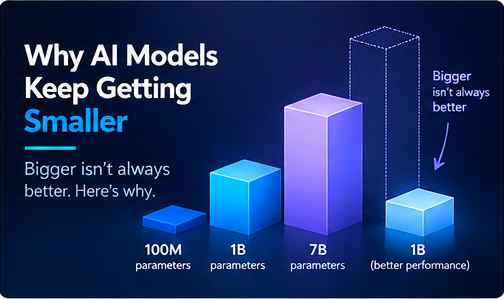
For years, one number dominated conversations about language models:
parameters.
7 billion.
70 billion.
Hundreds of billions.
The bigger number sounded like the better model.
That intuition was not completely unreasonable. Scaling models was one of the forces behind enormous improvements in AI capability.
But production engineering eventually asks a different question:
Better for what?
A model that is brilliant but takes too long, costs too much, requires expensive hardware and cannot run where your application needs it may be the wrong model.
That is why smaller and more efficient models have become increasingly important.
Not because “small beats large.”
Because model selection is becoming an engineering decision rather than a parameter-count competition.
First: what is a parameter?
A parameter is a numerical value learned during model training.
You can think of a neural network as an enormous mathematical system whose behavior depends on many learned numbers.
During training, those numbers are adjusted so the model becomes better at predicting useful outputs.
A model with 7 billion parameters therefore contains roughly 7 billion learned numerical values.
But parameter count is not an intelligence score.
Two models with the same number of parameters can behave very differently because of differences in:
- architecture;
- training data;
- training quality;
- post-training;
- tokenization;
- context handling;
- optimization;
- specialization.
So this comparison:
Model A: 70B parameters
Model B: 12B parameters

Therefore A is always better.
does not follow.
The larger model may have broader or deeper capability.
But the application does not care about parameter count by itself.
It cares whether the model performs the task reliably enough.
Imagine two employees
You need to classify support tickets into five categories.
Option A is a world-class generalist who can write essays, solve advanced problems, analyze images and discuss philosophy.
Option B has been trained specifically to categorize your support tickets quickly and accurately.
Which one should process 10 million tickets?
The answer is not automatically A.
If B meets the quality target while being faster and dramatically cheaper, B may be the better production system.
That is the small-model argument in one picture.
Bigger models pay a real infrastructure tax
Parameters need memory.
Computation needs hardware.
Hardware consumes power.
Serving requests takes time and money.
A larger model may require multiple accelerators where a smaller one fits on one device.
It may move more data through memory for every generated token.
It may be harder to deploy locally.
It may cost more per request.
This becomes important at scale.
Suppose an internal tool receives 100 requests a day.
The difference may be irrelevant.
Now suppose a consumer product receives millions.
A small per-request difference becomes an infrastructure strategy.
The local-AI example makes this concrete
Google’s Gemma 4 12B announcement in June 2026 is a useful example of the direction.
Google describes the 12-billion-parameter multimodal model as small enough to run locally on dedicated-GPU laptops with 16 GB of VRAM or unified memory.
That does not mean a 12B model is now universally better than a frontier cloud model.
It means something more interesting:
Useful multimodal AI capability can fit into hardware a developer can actually own.
That changes application architecture.
Cloud-only AI

Device
  ↓ internet
Cloud model
  ↓
Response


Local AI

Device
  ↓
Local model
  ↓
Response
Local execution can reduce network dependence, improve privacy for some workloads and remove round-trip network latency.
It also creates constraints: device memory, thermal limits, battery use and smaller-model capability.
Again, trade-offs.
How do models become smaller without simply becoming worse?
There is no single trick.
Several techniques attack different parts of the problem.
Distillation: teach the smaller model from a stronger one
Imagine an expert teacher and a student.
Instead of asking the student to rediscover everything from raw textbooks, the teacher provides high-quality examples and guidance.
Model distillation follows a related idea.
A larger or stronger model can help produce training signals for a smaller model.
The smaller model does not become an exact compressed copy of the larger one.
The goal is to transfer useful behavior into a model that is cheaper to run.
This can work especially well when the smaller model has a narrower job.
Quantization: store numbers with less precision
Model parameters are numbers.
Those numbers can be represented using different numerical precision.
Very roughly:
Higher precision
more bits per value
more memory

Lower precision
fewer bits per value
less memory
Quantization represents model weights --- and sometimes other values involved in inference --- using fewer bits.
That can substantially reduce memory requirements and improve serving efficiency.
The trade-off is that aggressive quantization can reduce quality.
The engineering question becomes:
How much precision can we remove before the quality loss matters for this application?
Specialization: stop paying for abilities you do not need
A general-purpose frontier model needs to handle an enormous range of requests.
Your application may need one.
Extract fields from invoices.
Classify emails.
Summarize support conversations.
Convert natural-language filters into SQL under strict constraints.
A smaller model trained or adapted for a specific domain can sometimes meet the target without carrying the full capability envelope of a giant general model.
“Small” is also relative
A 12-billion-parameter model would once have sounded enormous.
Today it can be discussed as a local or medium-sized model.
That should remind us that labels such as “small” and “large” are contextual.
The more useful questions are:
Can it do the task?
How reliably?
At what latency?
At what cost?
On what hardware?
With what privacy constraints?
Model routing turns this into a system design problem
You do not necessarily have to choose one model for everything.
Imagine an application receiving 100 requests:
80 simple requests
15 moderate requests
5 genuinely difficult requests
Sending all 100 to the most expensive model may be wasteful.
A routing system can attempt something like:
Request
   ↓
Classify difficulty / task
   ↓
┌───────────────┬────────────────┐
│ Simple        │ Difficult      │
│ small model   │ stronger model │
└───────────────┴────────────────┘
Now smaller models become part of an architecture rather than a philosophical position.
Use inexpensive capability where it is sufficient.
Escalate when necessary.
TechByteByByte’s AI Engineering learning path already treats model selection this way: across capability, cost, latency, privacy and deployment requirements rather than a single leaderboard number.
Why on-device AI matters
Consider a feature that summarizes private notes on a laptop.
A cloud model may require sending those notes to a remote service.
A capable local model can potentially process them on the device.
That can change the privacy boundary.
Or imagine an AI feature that must work without reliable internet connectivity.
Local inference becomes valuable for a completely different reason.
Or imagine a mobile application where every cloud call costs money.
Now unit economics matter.
Smaller models open architectural options that giant models cannot.
But don’t overcorrect: bigger models still matter
There is a new bad slogan waiting to replace the old one.
Old slogan:
Bigger is always better.
New slogan:
Small models are all you need.
Both are wrong.
A frontier-scale model may be the correct choice when:
- the task is genuinely difficult;
- broad world knowledge matters;
- reasoning depth matters;
- quality is worth more than marginal inference cost;
- request volume is low;
- you cannot afford to maintain specialized models.
A smaller model may be right when:
- the task is narrow;
- traffic is large;
- latency matters;
- cost matters;
- local execution matters;
- privacy favors on-device processing;
- quality remains within your target.
There is no model-size ideology in good production engineering.
There are requirements.
A useful model-selection checklist
Before reaching for the biggest model available, ask:
1. What quality do we actually need?
“Best possible” is not a measurable requirement.
Define success.
2. What is our latency budget?
Can the user wait 10 seconds?
One second?
100 milliseconds?
3. What does one request cost?
Then multiply it by expected traffic.
4. Where must the model run?
Cloud?
Private VPC?
Laptop?
Phone?
Edge device?
5. What data can leave the environment?
Privacy and regulatory constraints can eliminate options before benchmark scores matter.
6. Can we route difficult cases?
A hybrid architecture may outperform a one-model-for-everything decision economically.
The takeaway
The interesting shift is not that AI models are simply “getting smaller.”
It is that the industry is learning to extract more useful capability per unit of compute, memory, latency and cost.
Parameter count still matters.
But it is only one variable.
The production question is:
What is the smallest, cheapest, fastest model that reliably meets the requirements of this particular task --- and when should we escalate to something stronger?
That is a much more useful question than asking which model has the biggest number beside its name.
Related learning
Want to go deeper?
Sources
Continue reading
AI Engineering
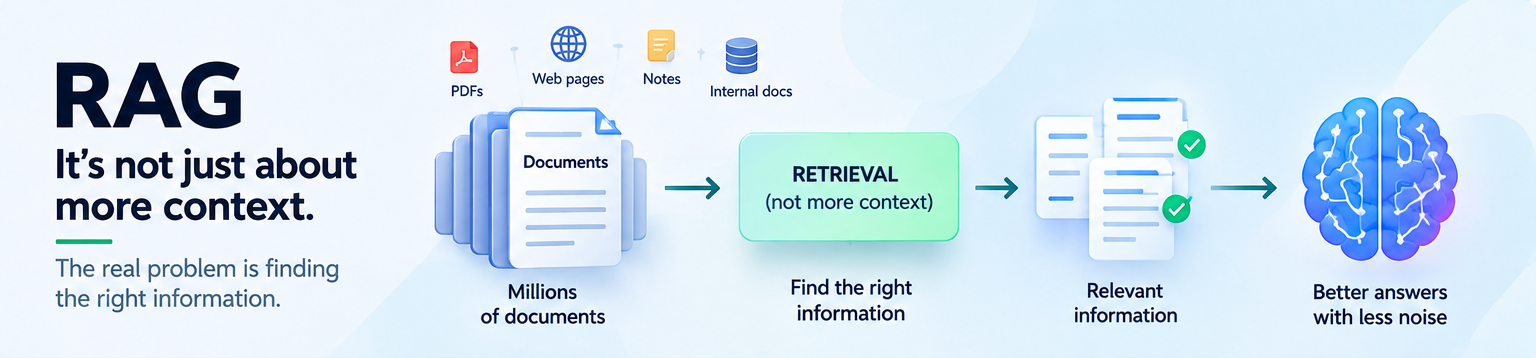
Why RAG Is Not Really About Giving an LLM More Context
RAG is often explained as giving an LLM extra information. That misses the harder engineering problem: finding the right evidence from everything you could possibly give it.
◷ 10 min read

Agents & LLMs
AI Agents Don't Really 'Think.' So What Are They Actually Doing?
AI agents can search, use tools, change plans and take actions. Underneath the magic is a surprisingly understandable software loop.
◷ 7 min read